
Subtotal $0.00

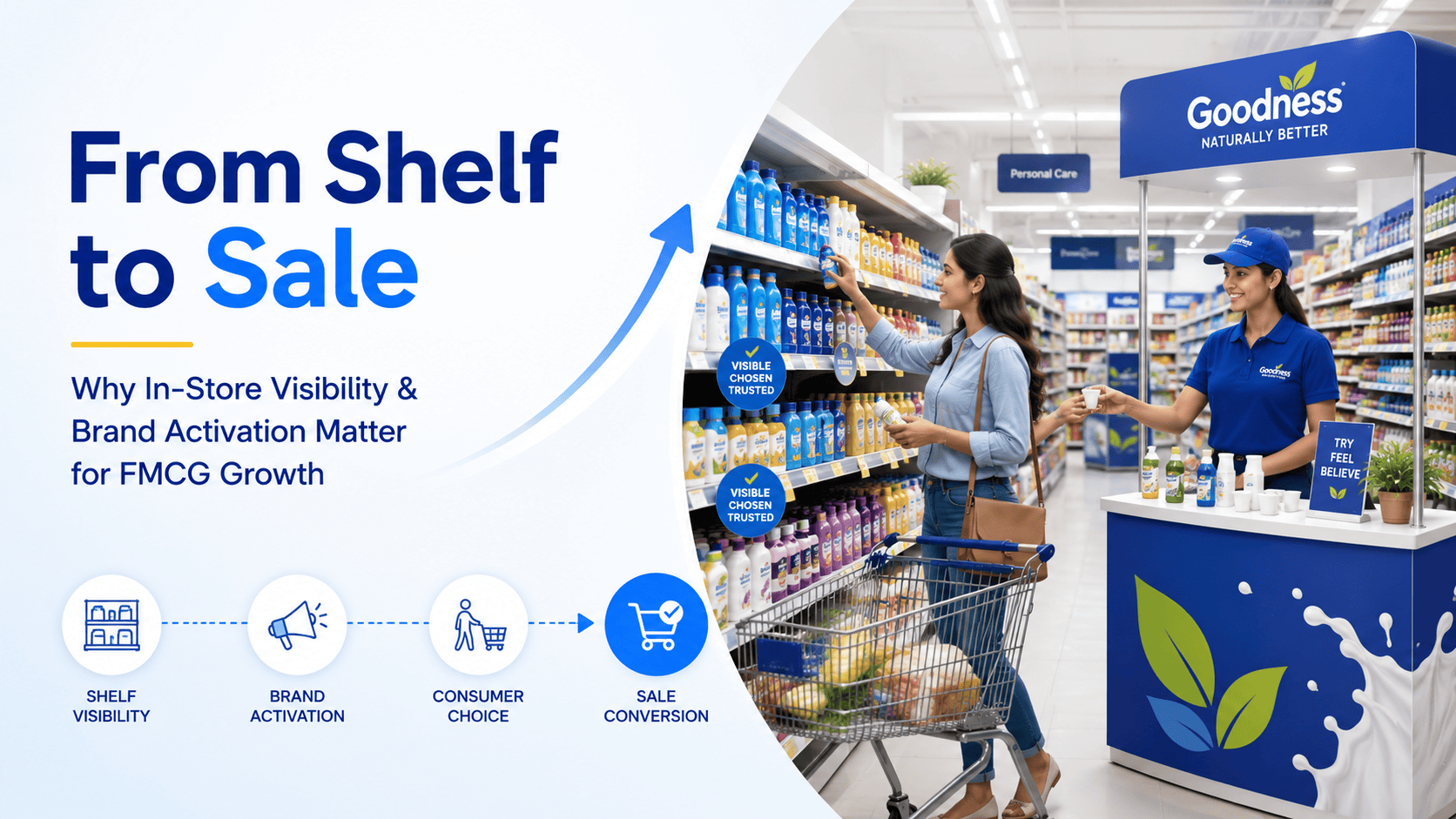
In the fast-moving consumer goods sector, getting a product onto the shelf is only the beginning.
The real challenge is getting consumers to notice it, understand it, choose it, and buy it.
FMCG categories are often highly competitive, with multiple brands fighting for the same consumer attention in supermarkets, retail stores, pharmacies, convenience outlets, and modern trade environments. In these settings, in-store visibility and brand activation can play a critical role in influencing purchase decisions and strengthening brand performance.
For FMCG companies operating in Pakistan, where consumers are exposed to a wide range of local and international brands, the ability to stand out at the point of purchase can directly influence awareness, trial, and conversion.
This is why effective FMCG brand activation in Pakistan must go beyond product placement. It should connect visibility, engagement, communication, and execution into one seamless consumer experience.
Why In-Store Visibility Matters for FMCG Brands
Retail environments are crowded.
Consumers may enter a store with one product in mind, but their final decision can still be influenced by what they see around them.
This makes in-store visibility a key part of FMCG marketing.
Strong retail visibility can help a brand:
- Capture consumer attention
- Reinforce brand recognition
- Improve product discoverability
- Support new product launches
- Encourage impulse purchases
- Strengthen category presence
- Improve recall at the point of sale
A product that is difficult to find, poorly displayed, or surrounded by stronger competitor visibility may lose attention even if it has strong brand awareness outside the store.
That is why FMCG marketing should consider not only how consumers hear about the brand, but also what they see when they are ready to buy.
From Awareness to Purchase
The consumer journey often moves through several stages:
Awareness → Interest → Consideration → Trial → Purchase → Repeat Purchase
In-store visibility sits close to the moment of decision.
A shopper who has already seen a product online, on social media, or through advertising may need one final reminder at the shelf.
That reminder may come from:
- Shelf placement
- Branded displays
- Point-of-sale materials
- Promotional signage
- Product sampling
- Retail activation teams
- Discount offers
- Product education
- Interactive brand experiences
When these elements work together, the retail environment becomes more than a sales space. It becomes a brand engagement platform.
What Is FMCG Brand Activation?
FMCG brand activation is a marketing approach designed to encourage consumers to interact with a brand and move toward a specific action.
Unlike passive advertising, brand activation is often more direct and experiential.
Examples include:
- In-store product sampling
- Branded kiosks
- Retail booth activations
- Consumer contests
- Promotional giveaways
- Live product demonstrations
- Retail merchandising
- Brand ambassador engagement
- Limited-time offers
- Interactive product education
- Mall activations
- Community activations
The objective is not just to create visibility, but to create engagement that supports consumer action.
That action may be trying the product, scanning a QR code, asking a question, making a purchase, or remembering the brand for future consideration.
1. Visibility Influences Consumer Attention
Consumers cannot choose what they do not notice.
In crowded FMCG categories, the first challenge is often simply getting attention.
High-visibility product placement, strong shelf presence, branded materials, and strategically placed displays can make a product easier to notice.
This is especially important for:
- New product launches
- Rebranded products
- Competitive categories
- Seasonal campaigns
- Limited-time promotions
- Products entering a new market
A strong visual presence can help a product stand apart from surrounding competition.
This is where retail marketing in Pakistan becomes especially important, because shopping environments can vary significantly across modern trade, traditional retail, supermarkets, pharmacies, and neighborhood outlets.
2. Brand Activation Encourages Product Trial
For many FMCG brands, trial is one of the most important steps toward conversion.
Consumers may hesitate to buy a product they have never used before.
Product sampling helps reduce that barrier.
A well-executed product sampling campaign in Pakistan can allow consumers to:
- Try the product
- Understand its features
- Compare it with alternatives
- Ask questions
- Receive guidance from trained brand representatives
- Make a more informed purchase decision
Sampling can be particularly effective for:
- Food and beverages
- Personal care
- Household products
- Wellness products
- Consumer health products
- New product launches
The more relevant the activation environment is to the product, the stronger the opportunity for meaningful engagement.
3. Retail Activations Make Brand Messages More Memorable
Advertising tells people about a brand.
Brand activation allows people to experience it.
That difference can improve recall.
A consumer may forget an advertisement they saw online, but they are more likely to remember:
- A product they sampled
- A promoter they spoke with
- A kiosk they interacted with
- A useful demonstration
- A promotion they participated in
- A positive retail experience
Experiential engagement creates multiple sensory and emotional touchpoints.
For FMCG brands, this can strengthen the association between the brand and the consumer need it is trying to address.
4. Point-of-Sale Execution Can Influence Conversion
Point-of-sale is one of the most important stages in FMCG marketing.
At this point, the consumer is close to purchase.
Small execution details can have a major impact.
These may include:
- Product availability
- Shelf positioning
- Price visibility
- Promotional messaging
- Clean and organized displays
- Stock consistency
- Branded signage
- Placement near relevant categories
- Promoter presence
A strong campaign can lose impact if the product is not available or difficult to find.
That is why retail execution needs to work alongside marketing and brand activation.
Visibility without availability does not convert.
Availability without visibility may not attract attention.
The strongest approach combines both.
5. Brand Ambassadors Can Improve Consumer Engagement
Trained brand ambassadors can help make the retail experience more personal.
Their role can include:
- Greeting consumers
- Introducing the product
- Explaining benefits
- Offering samples
- Answering basic questions
- Guiding consumers toward purchase
- Collecting feedback
- Supporting promotional activities
For FMCG companies, brand ambassadors can help bridge the gap between marketing communication and consumer understanding.
The quality of this interaction matters.
Brand representatives should understand:
- The product
- The campaign objective
- Key messages
- Target audience
- Engagement process
- Basic customer service
- Escalation of technical questions
A poorly trained promoter can weaken a campaign.
A well-trained promoter can make the experience more credible, engaging, and memorable.
6. In-Store Activations Generate Consumer Insights
Brand activations do more than support sales.
They can also generate valuable consumer feedback.
During an activation, brands can learn more about:
- Consumer preferences
- Purchase barriers
- Price sensitivity
- Product understanding
- Frequently asked questions
- Competitor comparisons
- Purchase intent
- Product perceptions
Feedback can be collected through:
- Short surveys
- QR forms
- Digital questionnaires
- Promoter observations
- Product feedback cards
- Informal consumer discussions
This helps brands understand what consumers are thinking at the actual point of interaction.
For FMCG businesses, this information can support improvements in:
- Messaging
- Product positioning
- Packaging
- Pricing
- Retail strategy
- Future activations
- Promotional planning
7. Retail Activations Support New Product Launches
Launching a new FMCG product can be challenging.
Consumers may not immediately understand why they should switch from familiar products.
In-store activation can support product launches by giving consumers a direct opportunity to learn about the new offering.
A launch activation may combine:
- High-visibility displays
- Product sampling
- Promotional pricing
- Demonstrations
- Brand ambassador engagement
- Digital content
- QR-based offers
- Consumer feedback
This approach can help move consumers from awareness to trial more quickly.
For brands entering new markets or introducing new variants, retail activation can provide a valuable bridge between national marketing campaigns and real consumer behavior.
8. Consistency Across Retail Touchpoints Builds Brand Recognition
A strong FMCG brand should look and feel consistent wherever consumers encounter it.
This includes:
- Shelf displays
- In-store branding
- Kiosks
- Promoter uniforms
- Packaging
- Digital advertising
- Social media
- Retail communication
- Promotional materials
Consistency reinforces recognition.
If the same visual identity, message, and positioning appear across multiple touchpoints, consumers are more likely to remember the brand.
This is particularly important in FMCG because repeated exposure often contributes to familiarity and trust.
9. Digital and In-Store Activation Work Better Together
Retail activation does not need to exist separately from digital marketing.
The strongest campaigns increasingly connect physical and digital engagement.
Examples include:
- QR codes on displays
- Social media contests
- Digital discount vouchers
- Online product education
- Lead capture forms
- Consumer feedback links
- Campaign hashtags
- Influencer amplification
- Retargeting campaigns
A consumer may first discover the product online, interact with it in-store, and then continue engaging with the brand digitally.
This creates a more connected customer journey.
For FMCG brands in Pakistan, integrating digital marketing with in-store activation can help extend campaign reach beyond the physical retail space.
10. Measurement Turns Activation into Strategy
A successful activation should not be evaluated only by how attractive the booth looked.
It should be measured.
Useful FMCG activation metrics may include:
- Footfall
- Consumers engaged
- Samples distributed
- Products sold
- Conversion rate
- Leads generated
- QR scans
- Consumer feedback
- Retailer participation
- Promotion uptake
- Repeat purchase indicators
- Cost per engagement
Tracking results helps organizations understand whether the activation achieved its objectives.
It also provides insight for future campaign planning.
This is especially important when brands want to move from one-off activations to a more structured FMCG growth strategy.
Why FMCG Brand Activation Matters in Pakistan
Pakistan’s FMCG market includes highly diverse consumer segments, retail environments, income groups, and purchasing behaviors.
A campaign that works in one market or retail format may not work the same way in another.
Brands therefore need to consider:
- Consumer demographics
- Retail format
- Geographic location
- Purchasing power
- Cultural relevance
- Language
- Product category
- Local competition
- Promotion sensitivity
This makes localized execution important.
An effective FMCG brand activation in Pakistan should be designed around the actual market environment rather than using a one-size-fits-all approach.
How PharmOSS Supports FMCG Brand Activation
PharmOSS supports FMCG and consumer brands with brand activation, retail engagement, field execution, and consumer interaction services in Pakistan.
Our capabilities may include:
- FMCG brand activation
- In-store activation
- Retail marketing execution
- Product sampling
- Kiosk and booth activations
- Brand ambassador deployment
- Consumer engagement
- Promotional activities
- Field force management
- On-ground campaign supervision
- Market feedback collection
- Activation monitoring
- Campaign reporting
Our approach combines strategy with practical field implementation to help brands improve visibility, increase engagement, and create stronger consumer connections.
From Shelf Presence to Consumer Action
For FMCG brands, the shelf is not just where the product sits.
It is where competition becomes visible and where many purchase decisions are made.
Strong in-store visibility, supported by well-planned brand activation and retail execution, can help brands:
- Stand out
- Encourage trial
- Improve recall
- Engage consumers
- Support conversion
- Generate insights
- Strengthen long-term brand presence
The goal is not simply to be present on the shelf.
The goal is to turn that presence into action.
Looking to Strengthen Your FMCG Brand Presence?
PharmOSS supports brands with end-to-end FMCG brand activation, in-store marketing, product sampling, consumer engagement, and retail execution services in Pakistan.
From shelf visibility to consumer conversion, we help brands create experiences that drive action.