
Subtotal $0.00
In healthcare and pharmaceuticals, building awareness is important—but awareness alone does not always create engagement, understanding, or trust.
Today’s audiences are exposed to hundreds of brand messages every day. To stand out, healthcare and pharmaceutical brands increasingly need to create opportunities for people to experience the brand, interact with it, ask questions, and understand its relevance in a real-world setting.
This is where experiential brand activation becomes valuable.
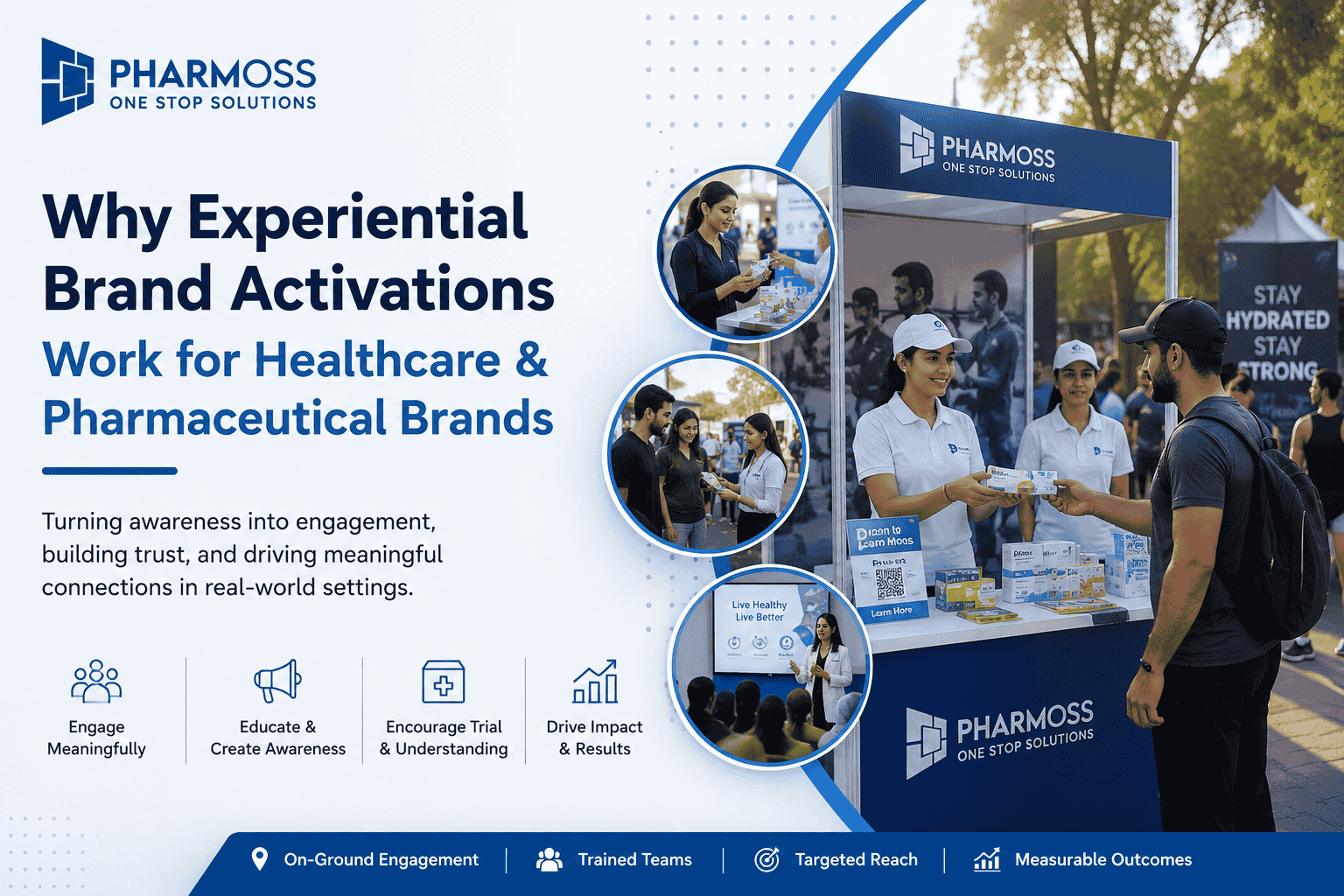
Experiential marketing brings a brand closer to its target audience through direct, interactive experiences such as product sampling, kiosks, booths, healthcare events, sports activations, awareness activities, institutional engagement, and community-based campaigns.
For healthcare and pharmaceutical organizations, these activations can help transform complex product or health messages into more meaningful consumer experiences.
What Is Experiential Brand Activation?
Experiential brand activation is a marketing approach designed to create direct interaction between a brand and its audience.
Rather than relying only on advertisements, digital content, or promotional materials, experiential activations allow consumers to engage with a brand physically and personally.
Examples may include:
- Branded kiosks
- Product sampling campaigns
- Healthcare awareness booths
- Gym and fitness activations
- Sports and marathon activations
- Hospital and clinic engagement
- Community health activities
- Corporate wellness campaigns
- HCP engagement activities
- Educational events and workshops
- Retail and mall activations
The objective is not simply to display a brand—it is to create an experience that helps people see, understand, remember, and engage with it.
Why Experiential Marketing Matters in Healthcare
Healthcare decisions are often more complex than ordinary consumer purchases.
People may need to understand:
- What a product does
- Who it is intended for
- How it may fit into their lifestyle
- Why a health issue matters
- When they should seek professional advice
- How a healthcare service can support them
Traditional advertising may introduce these messages, but direct engagement provides an opportunity to explain them more clearly.
Experiential marketing enables healthcare brands to create an environment where trained representatives can communicate information, respond to questions, and guide consumers toward greater understanding.
This makes brand activation particularly relevant for industries where education, credibility, trust, and responsible communication are important.
1. Brand Activations Create Direct Consumer Engagement
One of the biggest advantages of experiential marketing is that it creates a two-way interaction.
Consumers are no longer simply seeing an advertisement—they are engaging with a person, product, service, or experience.
For example, an onsite brand activation can allow consumers to:
- Explore a product
- Receive product information
- Ask questions
- Participate in sampling
- Interact with trained brand ambassadors
- Share their feedback
- Learn about relevant health or wellness topics
This direct engagement can make the brand feel more accessible and relevant.
For pharmaceutical and healthcare brands, it also provides an opportunity to communicate information in a more structured and responsible way.
2. Product Sampling Encourages Trial and Understanding
For suitable healthcare, wellness, and consumer health products, product sampling campaigns can be an effective way to encourage trial.
People are often more likely to understand a product after experiencing it rather than simply seeing it advertised.
Sampling activations can be particularly effective when conducted in environments closely connected with the product’s positioning.
These may include:
- Gyms
- Sports clubs
- Marathons
- Healthcare events
- Universities
- Corporate workplaces
- Shopping malls
- Community events
The right environment increases relevance.
A hydration-focused product, for example, may naturally fit within a sports or fitness environment where consumers are already thinking about hydration, energy, performance, and recovery.
Context therefore becomes an important part of the brand experience.
3. Healthcare Brand Activations Improve Brand Recall
Consumers tend to remember experiences more easily than passive advertising messages.
An engaging kiosk, meaningful conversation, product trial, educational interaction, or event experience creates multiple points of contact with the brand.
This can strengthen:
- Brand awareness
- Product familiarity
- Brand recognition
- Message recall
- Consumer engagement
Repeated visibility within the right environment can further reinforce the association between the brand and a particular consumer need.
For healthcare organizations, this helps move the audience from simply seeing the brand toward understanding what the brand represents.
4. Activations Put Brands in Relevant Real-World Environments
Location plays a major role in successful brand activation.
Instead of reaching everyone, brands can choose environments where the intended audience is naturally present.
A well-planned activation may target:
Fitness Consumers
Gyms, sports clubs, fitness events, and running events can create opportunities to engage audiences interested in health, exercise, nutrition, hydration, and wellness.
Healthcare Professionals
Hospitals, conferences, workshops, medical institutions, and professional events can facilitate structured healthcare professional engagement.
Communities
Public spaces, community centers, healthcare camps, schools, and local events can support awareness and public health initiatives.
Corporate Audiences
Workplace wellness programs and corporate activations can create opportunities to communicate health-related messages directly to employees.
Strategic location selection can therefore improve both audience relevance and campaign efficiency.
5. Experiential Campaigns Support Healthcare Education
Many healthcare campaigns require more than brand visibility.
They may also involve education around:
- Disease awareness
- Screening
- Prevention
- Lifestyle modification
- Treatment adherence
- Wellness
- Early diagnosis
- Healthcare services
Experiential activations create an opportunity to combine brand engagement with health education.
A well-designed kiosk or activation booth can include educational materials, trained personnel, interactive displays, digital tools, screening support, or awareness resources.
This makes experiential campaigns particularly useful when a brand wants to contribute to both commercial engagement and meaningful health awareness.
6. Trained Brand Ambassadors Improve the Experience
The people representing a brand can significantly influence how consumers perceive an activation.
Effective brand ambassadors should understand:
- The campaign objective
- Key brand messages
- Product information
- Appropriate communication
- Audience engagement
- Escalation of technical or medical questions
- Professional conduct
In healthcare environments, training becomes even more important.
Depending on the nature of the campaign, technical supervision by healthcare or pharmaceutical professionals can help ensure that information is communicated clearly, responsibly, and consistently.
The activation team should represent not only the campaign—but also the professionalism of the brand behind it.
7. Brand Activations Generate Valuable Consumer Feedback
Experiential marketing can also provide brands with useful real-world insights.
Consumers can be invited to share feedback through:
- Short surveys
- Digital forms
- QR-code questionnaires
- Product feedback cards
- Brand perception questions
- Interviews
- Onsite observations
This feedback can help organizations understand:
- Consumer perceptions
- Product understanding
- Questions and concerns
- Purchase intent
- Message effectiveness
- Audience preferences
- Future engagement opportunities
This makes brand activation valuable not only as a promotional activity, but also as a source of consumer insight and market learning.
8. Activations Can Connect Awareness with Conversion
A strong activation should have a clear purpose.
Depending on campaign objectives, this may include:
- Increasing product awareness
- Encouraging sampling
- Generating leads
- Supporting sales
- Collecting feedback
- Driving website visits
- Encouraging QR-code scans
- Building event participation
- Increasing health awareness
- Supporting healthcare referrals
When awareness, engagement, and a clear next step are connected, experiential marketing can support movement through the consumer journey.
Instead of ending with exposure, the campaign can encourage the audience to take meaningful action.
How to Plan an Effective Healthcare Brand Activation
Successful activation requires more than setting up a booth.
A structured healthcare brand activation strategy should consider several elements.
Define the Objective
Start by identifying exactly what the campaign needs to achieve.
Is the priority awareness, product trial, education, engagement, feedback, leads, or sales?
Understand the Target Audience
Identify who should be reached and where they are most likely to engage with the campaign.
Select the Right Location
Choose venues based on audience relevance, footfall, accessibility, and campaign objectives.
Develop Clear Messaging
Healthcare communication should be simple enough to understand while remaining accurate and responsible.
Train the Activation Team
Brand ambassadors and field teams should understand the campaign, product, communication guidelines, and engagement process.
Create an Engaging Experience
The kiosk, booth, activity, sampling process, displays, and educational materials should work together as one coherent brand experience.
Measure Performance
Track indicators such as:
- Consumers engaged
- Samples distributed
- Leads generated
- Products sold
- QR scans
- Feedback responses
- Event participation
- Awareness indicators
- Onsite interactions
Measurement helps determine what worked and how future campaigns can be improved.
Integrating Digital and On-Ground Brand Activation
Modern brand activations do not have to remain purely physical.
Digital tools can extend the experience beyond the activation site.
Brands can integrate:
- QR codes
- Landing pages
- Social media campaigns
- Digital feedback forms
- Online educational resources
- Event hashtags
- Lead capture forms
- Video content
- Retargeting campaigns
For example, consumers who engage with an onsite activation can be directed to a digital platform where they can access additional information.
This combination of on-ground engagement and digital marketing can help extend campaign reach and create a more connected brand experience.
Experiential Brand Activation in Pakistan
Pakistan offers significant opportunities for healthcare and pharmaceutical brands to engage consumers through targeted on-ground campaigns.
With diverse audiences across major cities, healthcare institutions, communities, workplaces, retail environments, fitness centers, and public events, organizations can develop highly targeted BTL and experiential marketing campaigns in Pakistan.
The key is to combine:
Strategy + Relevant Location + Strong Execution + Trained Teams + Measurable Outcomes
A campaign should not be treated as a standalone event. It should be designed as part of a broader brand, healthcare, or consumer engagement strategy.
How PharmOSS Supports Healthcare Brand Activation
PharmOSS provides brand activation and BTL campaign services in Pakistan for healthcare, pharmaceutical, wellness, FMCG, and corporate organizations.
Our capabilities can include:
- Brand activation strategy
- BTL campaign planning
- Kiosk and booth activations
- Product sampling campaigns
- Sports and fitness activations
- Community engagement
- Healthcare event activation
- Brand ambassador deployment
- Field team management
- Consumer engagement
- Onsite supervision
- Feedback collection
- Campaign monitoring
- Activation reporting
Our approach brings together strategic planning and on-ground implementation to help brands create experiences that are relevant, measurable, and aligned with campaign objectives.
From Brand Visibility to Meaningful Engagement
Healthcare marketing is evolving.
Audiences increasingly expect brands to do more than communicate—they expect them to create relevant and useful experiences.
Experiential brand activation provides an opportunity to combine visibility, education, engagement, trial, feedback, and action within one campaign.
When planned strategically and executed professionally, brand activations can help healthcare and pharmaceutical organizations build stronger connections with the audiences they want to reach.
Looking to Plan a Healthcare Brand Activation?
PharmOSS supports organizations with end-to-end healthcare brand activation, BTL marketing, product sampling, consumer engagement, and onsite campaign execution in Pakistan.
Turn your brand message into an experience your audience can remember.