Subtotal $0.00
- info@pharmoss.org
- 1st Floor, B-10, Block 16, WCHS, KDA Scheme No.24, Karachi
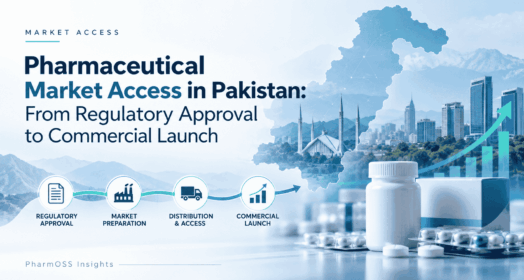
Entering the pharmaceutical market in Pakistan requires much more than obtaining regulatory approval. While product registration is a critical first step, successful pharmaceutical market access in Pakistan depends on how effectively a company understands the market, identifies the right partners, addresses pricing and access considerations, engages healthcare stakeholders, establishes distribution, and prepares for commercial launch.
For local and international pharmaceutical companies, the journey from regulatory approval to sustainable market presence therefore requires an integrated market access strategy.
Pakistan represents a large and diverse healthcare market with significant opportunities across pharmaceuticals, vaccines, biologics, biosimilars, diagnostics and other healthcare products. However, market complexity means that regulatory readiness and commercial readiness must be planned together.
The Drug Regulatory Authority of Pakistan (DRAP) is responsible for the evaluation, assessment and registration of pharmaceutical products in the country. Its Pharmaceutical Evaluation & Registration Division manages pre-market assessment, product registration, registration renewal and post-registration variations for locally manufactured and imported pharmaceutical products.
For pharmaceutical products for human use, DRAP has adopted the Common Technical Document framework, with applications submitted through Form 5-F in accordance with applicable requirements. Updated DRAP guidance also covers areas such as product information, labeling, post-approval variations, priority review pathways and regulatory reliance mechanisms.
Regulatory requirements continue to evolve. For example, submission of a Summary of Product Characteristics and Patient Information Leaflet is now mandatory for new drug registration applications, with requirements also extending to renewal applications from April 2026.
For companies considering entry into Pakistan, understanding the appropriate regulatory pathway early can help avoid unnecessary delays and align regulatory planning with broader market-entry objectives.
However, registration alone does not create market access.
Once a pharmaceutical product is approved, the next challenge is determining how it will successfully reach healthcare professionals, institutions, pharmacies and ultimately patients.
A commercially viable market access plan should address several questions:
Who are the priority patient populations and prescribers?
What unmet need does the product address?
How crowded is the therapeutic category?
Which competitors are already established?
What pricing and affordability realities influence adoption?
Which distribution channels are most appropriate?
What evidence or education will healthcare professionals require?
Which local commercial or strategic partners are needed?
These questions should ideally be explored before launch, rather than after regulatory approval has already been secured.

Companies entering Pakistan need reliable insight into the size and structure of the opportunity, existing treatment practices, competitor positioning, patient pathways, prescribing behaviour and potential barriers to adoption.
Market research may include engagement with:
Physicians and key opinion leaders
Pharmacists and pharmacy networks
Patients and caregivers
Hospitals and healthcare institutions
Distributors and channel partners
Other relevant healthcare stakeholders
Combining secondary market information with primary research can help organizations identify where the strongest opportunities exist and how the product should be positioned.
This is particularly important for international companies that may be familiar with the product category globally but have limited understanding of the realities of the Pakistan healthcare market.
Price can have a significant impact on pharmaceutical market access.
A product may demonstrate strong clinical value but still face adoption barriers if its pricing is not aligned with market realities, competitor products or patient affordability.
Pharmaceutical companies therefore need to evaluate pricing alongside the broader access environment, including the target patient population, therapeutic alternatives, channel structure and expected uptake.
DRAP also maintains a public pharmaceutical product price database containing registered product and pricing information, which can provide useful context during market assessment and benchmarking.
For new market entrants, the objective should not simply be to establish a price, but to understand how pricing, value perception and affordability interact with commercial potential.
For international pharmaceutical companies, selecting the right local partner can be one of the most important market-entry decisions.
Depending on the product and business model, this may involve identifying potential:
Importers
Distributors
Commercial partners
Licensing partners
Local manufacturers
Healthcare networks
The right partnership should be evaluated not only on geographic coverage but also on therapeutic expertise, regulatory capability, channel access, field-force strength, reputation and strategic alignment.
DRAP notes that manufacturers and importers with valid registration or marketing authorization can commercially import applicable therapeutic goods subject to regulatory requirements.
Regulatory approval permits a product to enter the market, but healthcare professionals ultimately need to understand where and how it fits within clinical practice.
Before launch, companies should map the stakeholders who may influence adoption and identify their information needs.
This can include:
Key opinion leaders
Specialist physicians
General practitioners
Pharmacists
Hospital stakeholders
Professional societies
Relevant institutional decision-makers
Market access also depends on whether the product can consistently reach the places where it is needed.
Commercial planning should therefore consider distribution strategy, geographic priorities, inventory requirements, pharmacy or hospital availability, supply continuity and channel monitoring.
For imported products in particular, regulatory approval, import requirements and distribution planning need to be aligned before launch.
A strong launch can quickly lose momentum if demand is created before sufficient supply or channel availability has been established.
Once regulatory, market, stakeholder and channel considerations have been addressed, the organization can move toward commercial launch.
The launch strategy should clearly define:
Who is the priority audience?
What unmet need does the product address?
How is it differentiated from alternatives?
Which stakeholders need to be engaged first?
Which channels and geographies should be prioritized?
What evidence and communication will support adoption?
The strongest pharmaceutical launches connect these elements into one integrated plan rather than treating regulatory, marketing, medical, distribution and commercial functions separately.
A successful product launch is only the beginning. Following commercialization, companies need to monitor market response, product availability, stakeholder feedback, competitor activity, adoption patterns and emerging access barriers.
Post-launch insights can help organizations refine positioning, strengthen stakeholder engagement, identify geographic opportunities and make informed lifecycle decisions. DRAP’s regulatory framework also includes renewal, post-registration variation and other continuing requirements, reinforcing that regulatory responsibilities continue beyond initial approval.
For this reason, pharmaceutical market access should be viewed as an ongoing process:
Assess → Navigate → Connect → Launch → Monitor → Grow
Successful pharmaceutical market access in Pakistan requires a coordinated approach that connects regulatory planning with market intelligence, partnerships, stakeholder engagement, distribution and commercialization.
For companies entering the market, the key question is not simply:
“Can we register this product in Pakistan?”
The more important question is:
“How do we build a sustainable pathway from regulatory approval to meaningful market adoption?”
At PharmOSS, we support healthcare and pharmaceutical organizations across the market-entry journey through market assessment, regulatory pathway support, local partner identification, stakeholder engagement, market positioning, distribution planning and commercialization strategy.
By combining local market understanding with strategic and execution capabilities, PharmOSS helps organizations turn market-entry opportunities into practical pathways for sustainable growth in Pakistan.